
Chopsticks: A Survival Tool of the East
Two little sticks that can pick up a single grain of rice. They look simple — but these small tools hold thousands of years of wisdom, and three nations’ very different ways of life.
Same Chopsticks, Different Shapes
All three East Asian countries use chopsticks, yet the shapes are quite different.
- China — long, round, and usually wooden. They have to reach across big shared tables, and the extra length suits handling hot, oily dishes.
- Korea — flat and oval, usually made of metal. Wooden ones are used too, but Korea is just about the only country that reaches for metal chopsticks every day.
- Japan — wooden, with pointed tips and a squared handle; the fine ends are shaped for lifting the small bones out of fish.
And one more thing — Korea is the only one that always pairs them with a spoon. In China, Japan, and Southeast Asia, soup gets a curved ceramic or plastic scoop called a renge. Koreans eat both rice and soup with a spoon.
Rice Is the Staple — So Why Chopsticks?
Here’s the curious part. Across most of East Asia, rice is the staple and the grains are tiny — yet everyone eats it with chopsticks.
Anything hard or awkward to grip is simply eaten with a spoon or renge. Use whatever you like. If you’re visiting from abroad, no one will mind in the least if you use a fork and spoon. You can even eat with your hands.
In Korea, only one thing really matters — that you enjoy your meal.
The Real Reason Korea Uses Metal Chopsticks — Hygiene
There’s a clear reason Korea settled on metal chopsticks: hygiene. Unlike wood, metal doesn’t soak up broth, shrugs off boiling-water sterilization, and doesn’t wear out over years of use.
And it isn’t only about chopsticks. Koreans have long favored notgeureut (traditional brassware) for their rice and soup bowls, and the royal court went a step further with spoons and chopsticks made of silver. Silver darkens on contact with certain poisons — so in an age when poisoning was a real danger, silverware was a safeguard all by itself.
Koreans have long carried a deep dislike of anything unclean. They favored white clothing so much they were called the baegui minjok, “the people of white” — and even today the best-selling car color in Korea is, without contest, white. That love of cleanliness lives on in the thoroughly washed metal chopsticks on the table.
The Two Things Korean Food Never Gives Up: Taste and Health
Honestly, only a tiny handful of Korean dishes ever get called bland. Food that is neither tasty nor nourishing is almost impossible to find.
In Korea, flavor naturally comes first, and health right after. Both are essential — if either one is missing, something just feels off.
The Western fuss over elaborate plating never really reached the everyday table. In ordinary homes and out in the countryside, it still isn’t the point. Eat comfortably, eat well, feel full and satisfied — that spirit has always ruled the Korean table.
It’s not that manners don’t exist. A few rules are firm — like waiting for the eldest to lift their spoon first — but the rest comes down to nunchi: quietly reading the room and minding your manners.
So Why Are the Three Countries’ Chopsticks Different?
Each country has its own reasons, and its own trade-offs. But here, I’ll speak only about Korea’s.
Other countries’ chopsticks surely carry deep histories I don’t fully know, and guessing on their behalf wouldn’t be respectful. Those stories are best asked of the people who live them.
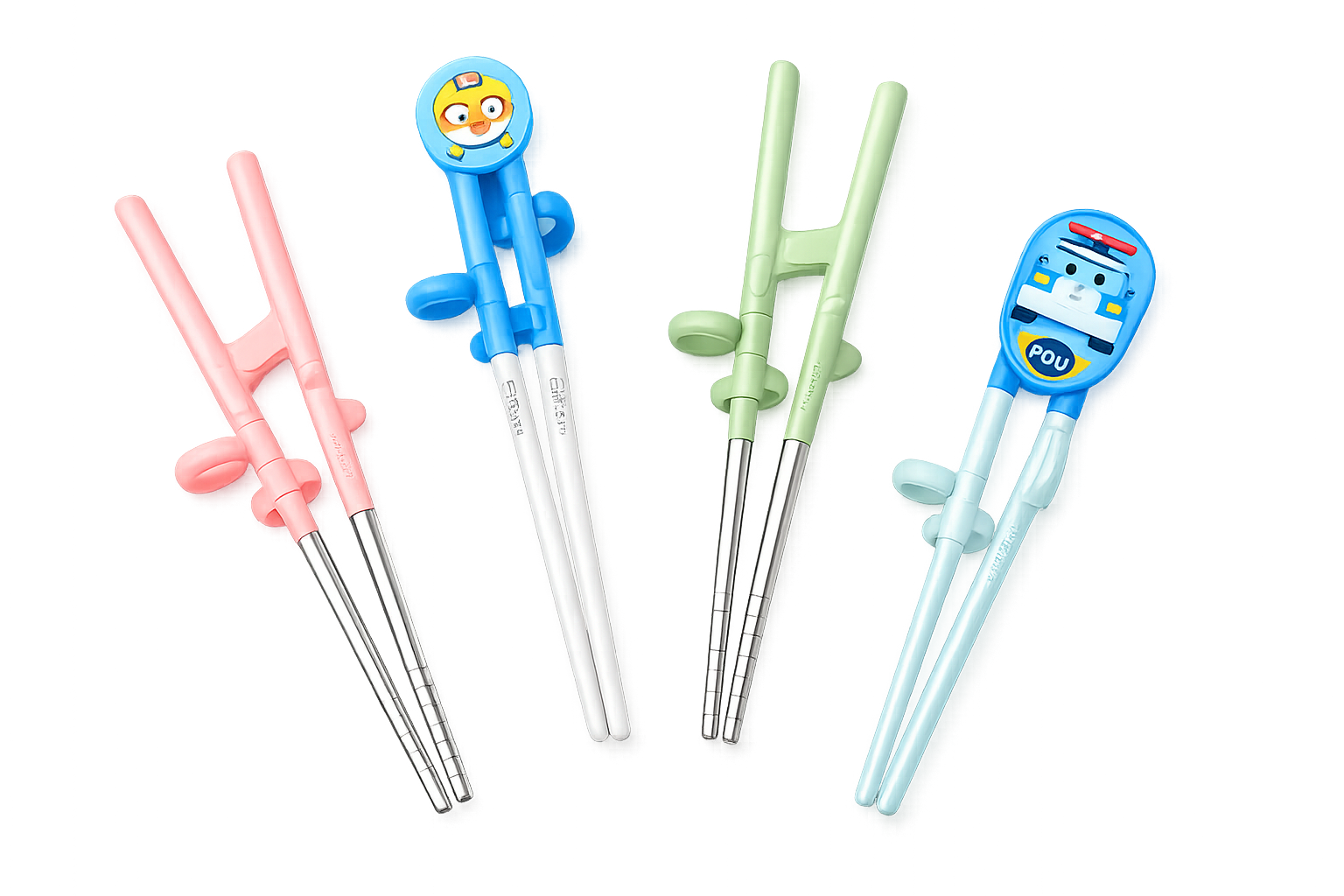
The Upside of Using Chopsticks
There’s an unexpected gift tucked inside all that practice.
- Brain development — using chopsticks fires up countless tiny muscles and nerves in your fingertips at once, giving the brain a lively workout.
- A delicate touch — you build real finesse for handling small things, which people say pays off both artistically and practically.
How to Hold Them, the Easy Way
The trick is simpler than it looks: keep the lower chopstick still, and move only the upper one. Brace the lower stick against the base of your thumb and your ring finger, then hold the upper one like a pencil and rock it up and down.
For children, explaining it in words rarely works. That’s why Korea makes wonderful children’s training chopsticks — fitted with little loops that hold the fingers in place and guide them into the right grip. If you get the chance, pick up a pair as a fun souvenir.